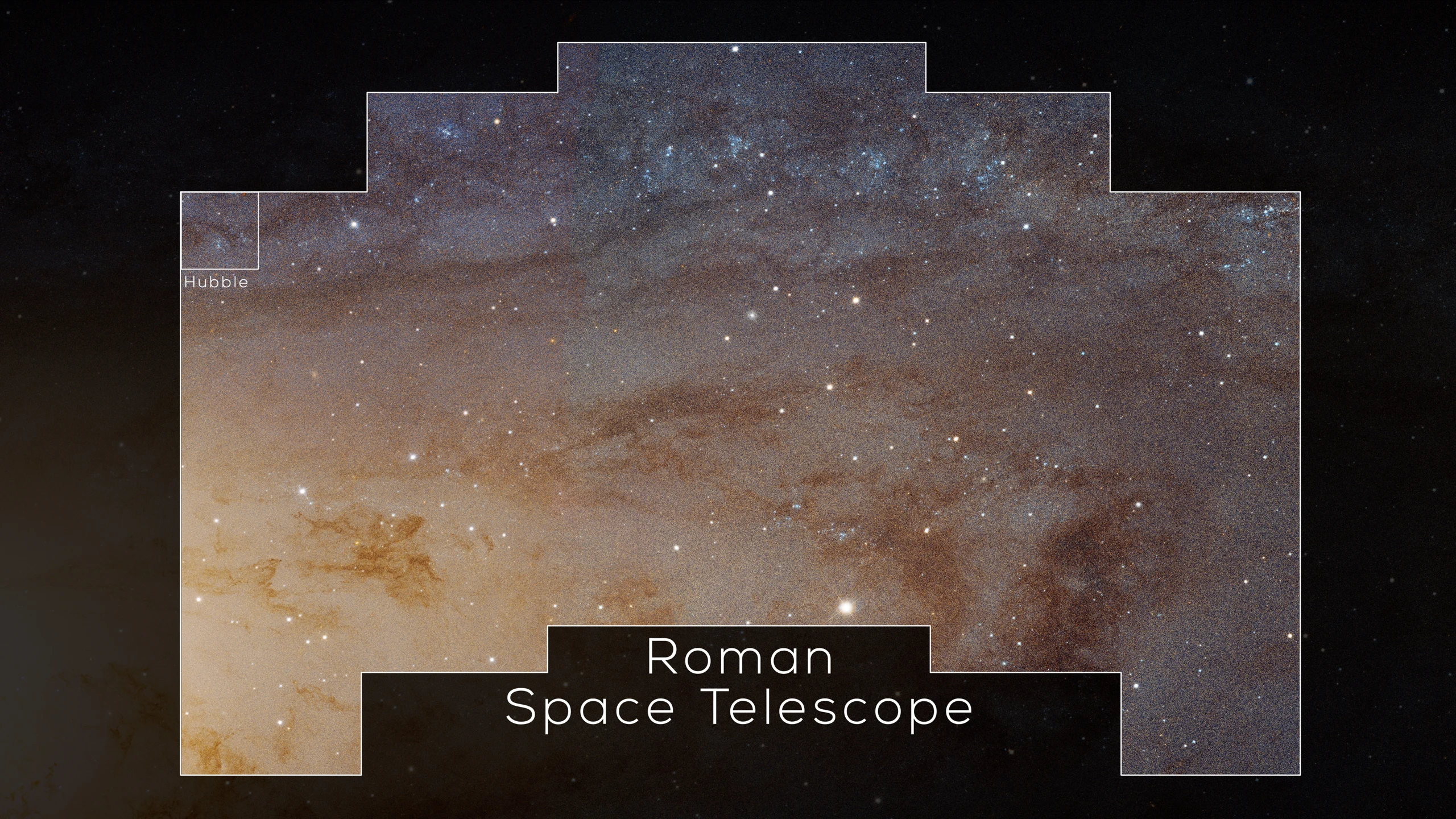
The large outline marks Roman’s field of view in a single exposure. The small square at the upper left marks the field of Hubble’s ACS camera. Both are shown at the same scale on a Hubble mosaic of Andromeda.
Credits: NASA, ESA, J. Dalcanton, B. F. Williams, L. C. Johnson, PHAT team, R. Gendler and S. Wiessinger (NASA GSFC).See NASA’s comparison
What Roman will look for.
How the universe expands
The brightness of Type Ia supernovae helps astronomers estimate distances. Combining those measurements with the distribution of galaxies and the slight distortions gravity produces in their images will help show how the universe’s expansion and the distribution of matter have changed.
Planets revealed by gravity
When a planet crosses in front of a distant star, its gravity can briefly amplify the star’s light. Roman will look for those changes towards the centre of the Milky Way. It will also test a coronagraph that dims starlight so much fainter objects nearby can be seen.
Roman and Euclid.
Euclid maps a larger part of the sky. Roman will cover a smaller total survey area and can detect fainter objects in the infrared. The bars show the area of a single pointing in square degrees.
Roman launched on 30 August 2026. NASA shared a test image in September to help adjust focus and confirmed instrument alignment on 13 November. The agency expects to release the first science images by early 2027.
Roman’s science data will become available in MAST when released, with no period of exclusive access for observing teams.