
EXOPLANETS / A planetary system
HR 8799
Four worlds. In motion.
A WORLD APART
Four worlds. In motion.
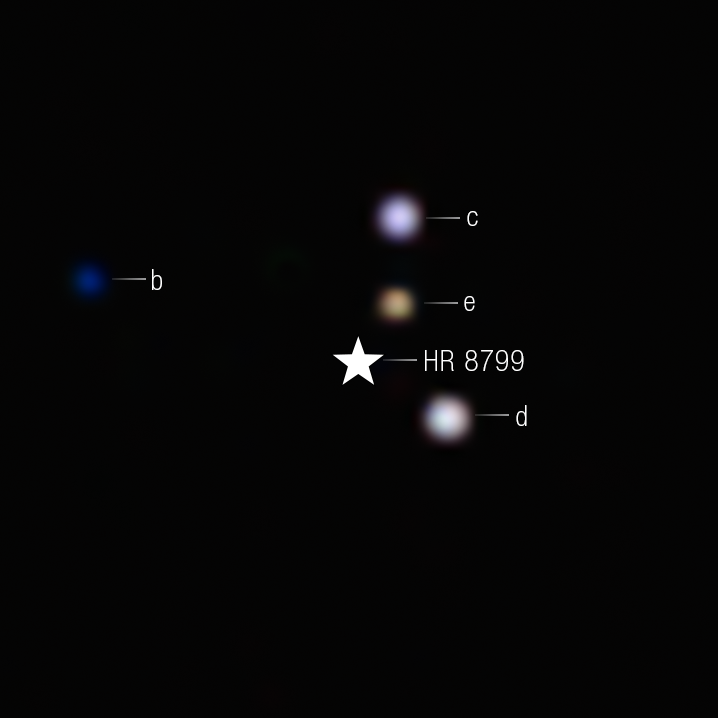
A faint point of light becomes something extraordinary when you know what it is. Around the young star HR 8799, astronomers have directly imaged four planets, each more massive than Jupiter. We see the infrared glow of these young giants, rather than detailed views of their cloud tops.
The Webb image brings all four into view while a coronagraph suppresses the star’s overwhelming glare. In the Keck sequence below, observations taken across seven years reveal their changing positions. The motion is enormously accelerated: a real orbit takes decades to centuries.
- giant planets imaged
- 4
- light-years from Earth
- ≈130
- of observations in the film
- 7 years
A CLOSER LOOK
Seven years, in a few seconds.
Watch the four planets change position around their star. The central light is masked so their faint glow can emerge.
How we know
These are processed telescope observations. Webb’s colours represent different infrared wavelengths; the star symbol marks the masked star. The Keck film combines observations across seven years and orbital fitting. Neither piece resolves planetary surfaces.
Sources & image credits
Webb image: NASA, ESA, CSA, STScI, Laurent Pueyo (STScI), William Balmer (JHU), Marshall Perrin (STScI).
Keck sequence: J. Wang et al. · CC BY 4.0.