
EXOPLANETS / A hot gas giant
HD 189733 b
Blue. And blisteringly hot.
A WORLD APART
Blue. And blisteringly hot.
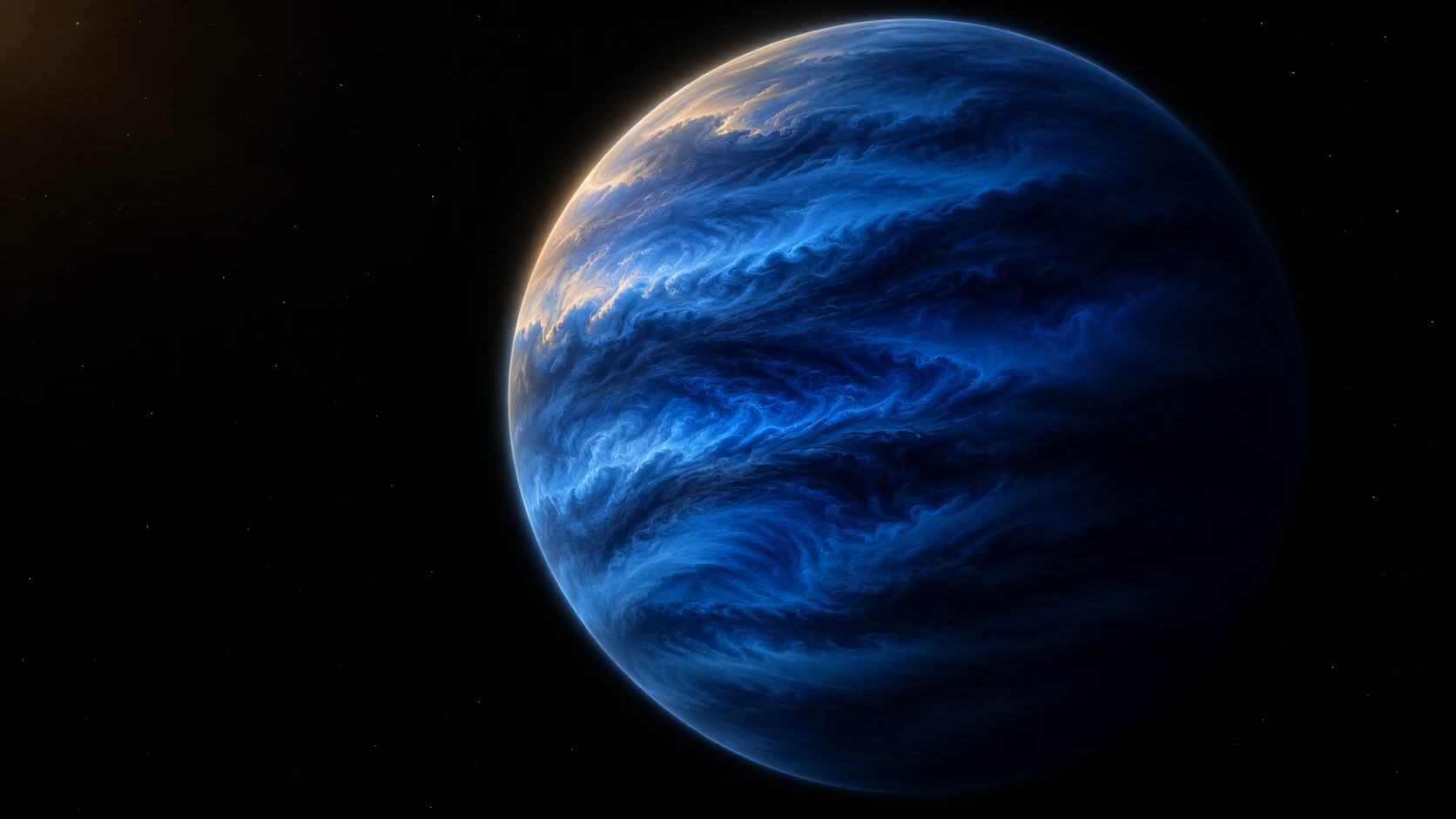
From afar, blue can feel reassuring. On HD 189733 b, it belongs to a huge gas planet in a punishingly hot orbit near its star. Hubble measured the planet’s visible colour by comparing the system’s light before, during and after the planet disappeared behind the star.
Its deep blue is therefore grounded in observations. The detailed cloud patterns in our illustration are imagined. There are no known oceans beneath that blue: researchers have linked the colour to light scattering in a hazy atmosphere, with silicate particles among the proposed ingredients. The planet is a reminder that a familiar colour can hide profoundly unfamiliar conditions.
- colour measured with Hubble
- Blue
- a scorching atmosphere
- >1,000 °C
- a very different world from Earth
- Gas giant
A CLOSER LOOK
The colour hidden in starlight.
When the planet slips behind its star, its contribution to the system’s light disappears. Comparing the light before and during that eclipse helped reveal its blue colour. Schematic; sizes and distances are not to scale.
How we know
Hubble measured changes in the system’s light during an eclipse, allowing astronomers to infer the planet’s blue colour. Our LUME illustration interprets that result; it is not a photograph or a measured cloud map.
Sources & image credits
Original LUME GRAVITY visualisation. The illustration is an interpretation, not telescope imagery. The comparison graphic is a LUME Gravity schematic.