LUME GRAVITYEspañol

First encounter · 29 March 1974

Three dates with Mercury

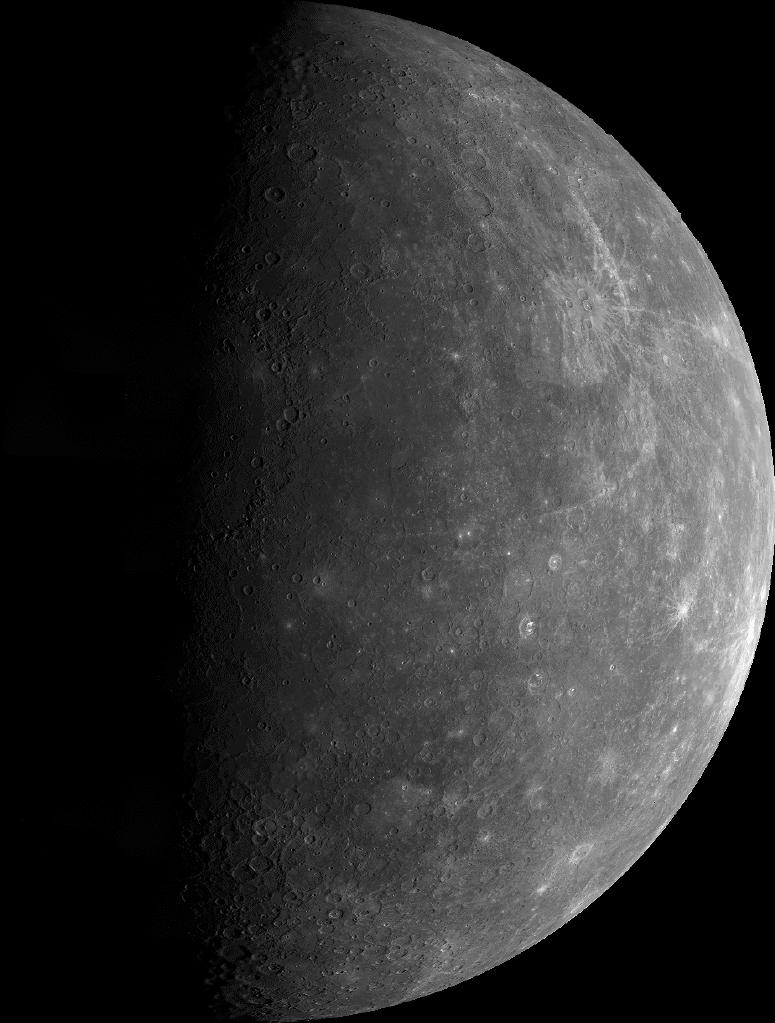
Mariner 10 was already leaving Mercury behind when it took the pictures in this mosaic. Another lap around the Sun lay ahead. How did the spacecraft manage to meet the same planet twice more?

Mercury as Mariner 10 departed. Sunlight picks out the curved limb on the right. On the left, the craters fade into night.
Mariner 10 mosaic · More than 140 frames, taken about two hours after the first encounter.

Giuseppe “Bepi” Colombo

One lap for the spacecraft, two for Mercury

In 1970, while the mission was still on the drawing board, a mathematician from Padua looked beyond the first flyby. If the spacecraft took twice as long as Mercury to orbit the Sun, the two could meet again.

A gravity assist from Venus sent the spacecraft towards Mercury. The team refined its course for another encounter some 176 days later.

Move ahead 88 days. Mercury has made a full lap. Where is the spacecraft?
29 Mar 1974
First encounter

Mercury and the spacecraft meet. The clock starts here.

0

Idealised orbits for comparing periods. Distances and sizes are schematic.

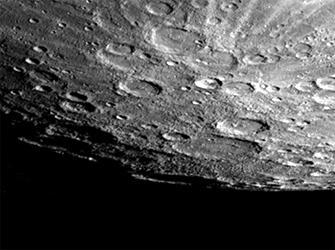
Cratered ground in Mercury’s south. A bright rim catches the sunlight at the lower edge of the picture.
Second encounter · 21 September 1974. Mercury’s south pole lies on the right rim of the crater Chao Meng Fu, close to the dark area at the bottom.

Why was half the map still missing?

In September, Mariner 10 flew over the south. In March it came back, this time passing just 327 km above the surface. After three visits, why was the map still incomplete?

See what the sunlight reveals

On Mercury, about 176 Earth days pass between one sunrise and the next. That was also the time the spacecraft took to return. The camera angle changed, but sunlight fell on much the same terrain. Together the three visits photographed about 45% of the surface.